Why it exists
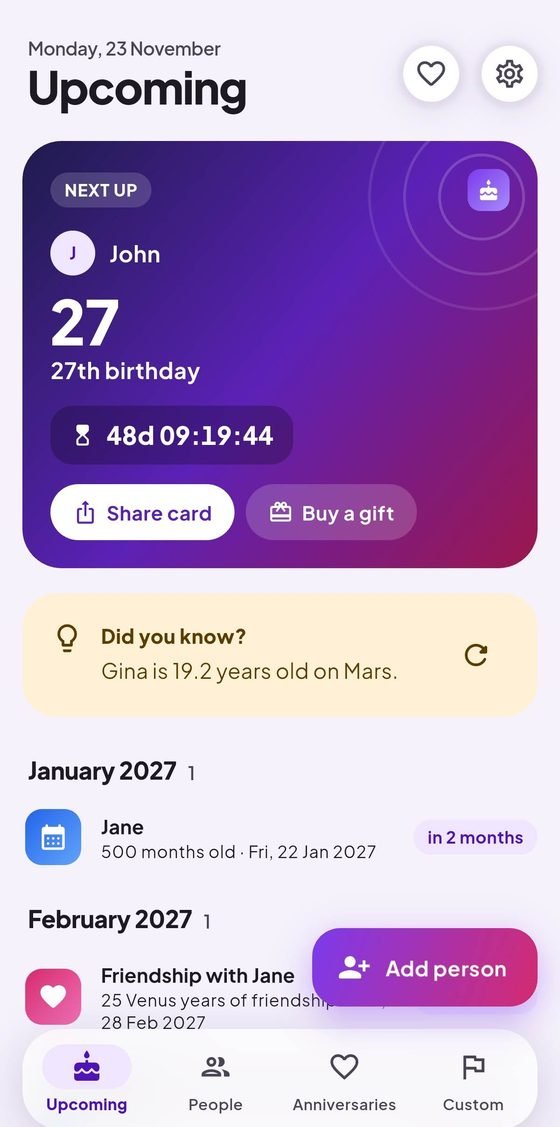
Birthday apps track many people but only count in years. Day-counter apps count in days but only for one event of your own. Timeversary does both: it covers the whole circle of people you care about and counts in every unit, so you hear about the milestones nobody else notices.
The idea is simple. People already love round numbers. Couples in Korea celebrate 100 and 1,000 days together. Some people throw a party when they turn 10,000 days old, or a billion seconds. Timeversary finds these dates for everyone you love and reminds you in time.
Who makes it
Timeversary is made by an independent developer in Europe, who designs the app, writes the date engine, tests it and writes this website. There are no investors and no advertisers.
How the numbers are worked out
The website and the app share one date engine, so their answers always match. It is tested against hundreds of hand-checked dates, including leap days and birth times.
The length of the calendar year over a 400-year cycle. Days, weeks and months are counted on the calendar: someone born on 31 January is 1 month old on the last day of February.
Without a birth time, they count from noon and show the day only, never a made-up minute.
The orbital periods in NASA's planetary fact sheet: 88 days for Mercury, 687 days for Mars, 10,747 days for Saturn.
Distances are rounded light-years, and catalogues differ slightly.
Dogs and cats follow the vets' rule of thumb (15 human years for the first year, 9 more for the second, then 4 or 5 a year). Other animals scale by their typical lifespan against a human lifespan of 80 years.
Privacy
Read the privacy policy to see how Timeversary handles data.
The website answers once. The app remembers.
- Add everyone you love, from contacts or with one link
- A reminder before every milestone, in every unit
- Planets, stars and 16 animals
- Free to start